Wednesday, March 11, 2015

A Nation of Savages

This unit we are examining the causes of the civil war, specifically slavery. Looking at back at America's slavery history it seems like a simple decision to either allow slavery or not, and to us it's a no brainer to not enslave people. But this wasn't the case in the 18th and 19th centuries. As time went on abolishing slavery became a more complex task, by the early 19th century it was economically entrenched in American society.

Slavery had been a part of American society since the country's establishment. It is mentioned in the constitution that slaves can't be freed by escaping to free states and they must be returned to their owners.
No Person held to Service or Labour in one State, under the Laws thereof, escaping into another, shall, in Consequence of any Law or Regulation therein, be discharged from such Service or Labour, but shall be delivered up on Claim of the Party to whom such Service or Labour may be due. (Article 4, Section 2, Clause 3)
In the late 18th Century people believed slavery to be coming to an end, with the ideas of liberty expressed in the French and American revolutions, it seemed slavery was on its way out. However, Eli Whitney's invention of the cotton gin turned that around drastically. (A video showing how it works) With cotton being cheaper and easier to produce the industry expanded rapidly. But to make more cotton, these huge plantations would require a lot more workers. And the most profitable kind of employment? Slave labor.

This website shows the increase of cotton production, slavery, and export value between 1790 and 1860
The growth in slave population was mostly in the South, as the cotton industry moved South West the slaves followed; drifting further from the North. The cotton industry boomed in the south bringing in huge amounts of profit using their slave labor. However, while the cotton industry was located in the South, the North also benefited from the rise in production. They used the cotton in textile mills so instead of shipping in or paying more for their resources, the plentiful source of cheap cotton made their industry more profitable too.

This racially based system of slavery was unsurprisingly problematic in creating a white superiority complex that has continued to be an issue to this day. The general mentality of the American population grew so warped from years of validated mistreatment towards black people and social prejudice. George Fitzhugh, a sociologist from North Carolina in the mid 1800s wrote:
The Negro slaves of the South are the happiest, and, in some sense, the freest people in the world. ... The women do little hard work, and are protected from the despotism of their husbands by their masters. ... [The free laborer] is more of a slave than the Negro, because he works longer and harder for less allowance than the slave, and has no holiday, because the cares of life begin when its labors end. He has no liberty, and not a single right. . .. Free laborers have not a thousandth part of the rights and liberties of the Negro slaves. Indeed, they have not a single liberty, unless it be the right or liberty to die.
The whole thing is absurd. It completely disregards every aspect of slavery and even goes so far as to make slave owners the victim in this situation. Escaped slave, Frederick Douglass, was a bit more accurate in his accusation of oppression,

Morality of Slavery Documents

He calls out white Americans on their hypocritical celebration of freedom, they celebrate liberty while enslaving a huge amount of the country's population. When he says the people of the United States are guilty of the most shocking and bloody practices in the world, he refers to their ignorance of humanity but also how terrible the slavery system was here.

Over the course of a few days we watched a movie in class, Prince Among Slaves, in which Abdulrahman Ibrahim Ibn Sori, an African prince, is taken from his homeland to be sold into American slavery. He himself owned slaves back in Futa Jallon but the two systems of slavery were very different. In Africa they didn't buy and sell slaves as property; they enslaved war prisoners they had captured. These slaves worked separately from their owners, rarely seeing them. They were allowed to own property and by the 3rd generation, they were pretty much freed. Any children born of a free father and enslaved mother were born free.

As Abdulrahman learned, slavery in Mississippi was much worse. Slaves there had been randomly kidnapped and were bought and sold as if they were animals rather than humans. They worked closely with their owners, constantly under supervision and they were ruled by fear. It was impossible to get out of American slavery, your future family would be born into it and any child conceived by a free parent and slave was also raised a slave. Both cultures had slaves work different kinds of jobs, not just field work. And both enslaved outsiders; Non-muslims were the enslaved because of their religion in Futa Jallon and black people were enslaved in America for their race. Neither allowed slaves to travel without permission.

In America, Abdulrahman's noble status earned him nothing but a sarcastic nickname of "Prince". His education was also not respected, even though he was fluent in multiple languages. He was broken of his pride and forced into submission to his owners. The Americans saw him as nothing more than property. When sold at auction he was examined like an animal, checked for any noticable illnesses or disabilities. The system of slavery in America ignored every human characteristic of the enslaved humans and treated them as animals for no reason other than their race.

Monday, March 2, 2015

procrastiNATION: The US Government Avoiding Big Issues

During the 19th century American politicians discussed, argued over, and made laws regarding the issue of slavery in the country. All their debates however, focused on resolving a short term issue in a way that just made everyone happy enough for the time being. The actual large topic of slavery in America was avoided as much as possible to push off the large decisions that would inevitably cause extreme controversy and massive upset. Through these years of politics the debate over slavery was the elephant in the room so to speak. Everyone knew it was there but no one wanted to talk about it so instead they dealt with little problems that came along as a result and didn't bring up the large issue. To look at how the United States did deal with the smaller concerns and how they all fit together, our class examined eight events predating the civil war and whether the result was in support of or against slavery.

Pro-Slavery outcomes are on the bottom of the timeline
Anti-Slavery outcomes are above the line


 In 1820 the Missouri Compromise was agreed upon to keep the number of slave states equal to the number of free states so each side would have an equal number of representatives to vote on issues. In the compromise Missouri was established as a slave state and Maine, a free one. Slavery creeping North freaked out Northerners and so it was decided that any state above the 36 degree latitude line would have to be free, except Missouri. But then with the gold rush to California, the golden territory's population had grown so it could officially be the golden state. The inhabitants of California wanted to be a free state, which would again threaten the balance of slave/free states. Other issues were also surfacing at the same time; new land won from Mexico was yet to be declared slave or free, Texas was having border disputes, and the capital city was the largest slave port in North America.  The compromise of 1850 had 5 parts to it to best appease all parties without fully prohibiting or encouraging slavery. To make Northerners happy Washington DC outlawed the sale/purchase of slaves in the city. While owning slaves was still legal there it put a limit on slavery and was progress towards freedom. Also, California was admitted as a free state since the poor workers who moved there for work couldn't afford slaves and didn't want to compete against slave labor.

In favor of slavery three more parts of the compromise were created. Texas gave up the land in question in exchange for $10M, even without the Mexican land it remained the largest slave state in the union. As for the other land acquired in the war New Mexico, Nevada, Arizona, and Utah were declared territories and slavery was not mentioned either way until decided upon by the inhabitants upon request for statehood. It was a very vague and unhelpful rule, erring on the side of slavery supporters since all they needed to do was fill up the areas with people who were pro-slavery. But the worst component was the Fugitive Slave Act. It required that all citizens had to assist in the recovery of escaped slaves and then denied the slaves the right to a jury trial. A slave that had escaped to a free state and lived there for years would be tracked down and dragged back to slavery, or even a free black person, without a jury trial it was easy to just say someone was enslaved and legally own them.
The compromise of 1850's five parts were designed to each smooth over a problem caused by the sectional freedom throughout the United States while continuing to keep slavery a fragmentary system in the growing nation.

Map of free/slave states after the Compromise of 1850 and the Kansas-Nebraska Act


To further complicate the issue of slavery, the Kansas-Nebraska Act defined the midwestern territories of Kansas and Nebraska and left them up to inhabitant vote to decide free or slave state. The possibility of slavery in the two territories overturned the Missouri Compromise line of freedom, but didn't concern Northerners too much since they thought the land wouldn't be good for cotton production. By now the land in the middle of America was mainly undeclared on its laws towards slavery and would remain impartial until the territory applied to become an official state. Then, the people living there would simply vote on the matter, majority rule.

Well owning people as property was a highly controversial issue and thus, unsurprisingly, the race to fill states with advocates for each side turned violent with the gruesome events of Bleeding Kansas.
The territory was open to be either slave or free; each side only needed to populate enough to win the vote. Each group swarmed the area and 2 separate capitals were set up. The anti slavery capital was burned down and John brown gathered a small army and brutally murdered pro slavery families in retaliation.


The last example of American politicians trying to deal with things short term instead of fixing the cause is the Dred Scott Decision. It started when Dred Scott tried to legally gain freedom through the court system of America. He claimed he and his wife were free because they were owned in states where slavery was illegal. This was a bad decision for him, the justice system doesn't care about a slave's technicalities, and it backfired badly. The results of this trial were not good and it was decided that slaves, because they are not citizens, were denied the right to sue in court;
"...they are not included, and were not intended to be included, under the word "citizens" in the Constitution, and can therefore claim none of the rights and privileges which that instrument provides for and secures to citizens of the United States."
enslaved people could not win freedom simply by living in a free territory or state; the Missouri Compromise was ruled unconstitutional and all territories were opened to slavery. In the ruling the court is careful to focus on the fact that each state sets its own laws and the federal courts do not have jurisdiction in any slave matters since the laws vary between states. Each government pushes the responsibility of making decisions about the big problem of slavery onto other people. The national government makes it the states' individual problem and then the states leave it to whatever the people vote for. Each government only steps in to smooth over small issues that arise and don't acknowledge the cause of them. Eventually the built up tension must be dealt with and it is once the civil war breaks out. 

Friday, January 16, 2015

There is Then Creative Reading as well as Creative Writing

"Our age is bewailed as the age of Introversion. Must that needs be evil? We, it seems, are critical; we are embarrassed with second thoughts; we cannot enjoy any thing for hankering to know whereof the pleasure consists; we are lined with eyes; we see with our feet; the time is infected with Hamlet's unhappiness, — 
"Sicklied o'er with the pale cast of thought."
Is it so bad then? Sight is the last thing to be pitied. Would we be blind? Do we fear lest we should outsee nature and God, and drink truth dry? I look upon the discontent of the literary class, as a mere announcement of the fact, that they find themselves not in the state of mind of their fathers, and regret the coming state as untried; as a boy dreads the water before he has learned that he can swim. If there is any period one would desire to be born in, — is it not the age of Revolution; when the old and the new stand side by side, and admit of being compared; when the energies of all men are searched by fear and by hope; when the historic glories of the old, can be compensated by the rich possibilities of the new era? This time, like all times, is a very good one, if we but know what to do with it."
Emerson, Ralph. "The American Scholar" In Nature; Addresses and Lectures. 1849. Ralph Waldo Emerson Texts. http://www.emersoncentral.com/amscholar.htm (accessed January 11, 2015)

Emerson gave this speech on his Trancendentalistic ideal for America to the Phi Beta Kappa Society, at Cambridge, August 31, 1837. American society at the time had been stuck in European ideas even though the country had been independent for a while it was difficult for citizens to figure out what defines America. The country isn't moving forward because everyone is hung up on the great things of the past and tries, instead of using them as inspiration, to recreate something which has already been done. Emerson also recognizes the growing separations between people in the United States, he believes that if each person can focus on their self and find their power they would be able to connect to each other. Everyone is a part of the whole but each piece needs to trust itself in order to work together. 

It's pretty long and complex but it's really worth reading the whole thing The American Scholar

Power (to the People) Point

Andrew Jackson's actions as president of the United States are not looked back on fondly by many people today. Yet he's the face of our most popular dollar bill and praised by Americans today. He may have made some pretty bad decisions and caused a lot of problems in the long run, but his time in office was a time when democracy was still finding its way in American government. The essential question of this lesson was, Is Andrew Jackson's long-standing reputation as "the people's president" deserved? Why? Why not? 

Watching videos from TED Ed and Crash Course provided general information and then we split into groups to focus on one of the main aspects of Jackson's rule. The first group focused on the worst thing Jackson did during his tenure, the Indian Removal. He forced five tribes to move off their own land and go somewhere they knew nothing about. Jackson claimed it was beneficial for them to relocate far away from white settlements so the groups would no longer have conflicts.The natives of course argued that they had a right to live on their land and had fought on America's side before, it wasn't fair to make them move to an unknown area that they had no resources in.  Jackson however keeps going with his plan and tells congress it must be voluntary, acting as though he knows what is best for the natives and those savages don't know what they're talking about. A lot has changed since then, like the definition of "voluntary" apparently, because pretty soon military force was used to put the natives in concentration camps and then on a winter death march known as the "Trail of Tears".

The next group explained his implementation of "The Spoils System", a tactic in which the leader removes government workers and replaces the position with their own supporters as a reward for their loyalty. Jackson fired 919 people and employed his allies, bribing them with positions of power in exchange for their help. This scheme valued loyalty over competence and ability. Jackson claimed the rotation in employment would spark stimulating ideas from these freshly motivated workers. It worked out really well, especially when he put a longtime supporter, Samuel Swartwout in charge of collecting from the Port of New York's, one of the most valuable in the country. Swartwout ended up stealing $1,222,705.09 from the country, unsurprisingly enough seeing how Jackson had ignored his known proclivity towards criminal activities and warnings that he was making a bad decision from other political leaders, such as Van Buren. 

He also worked to destroy the federal banks in America in "The Bank War"


It may have largely contributed to causing the worst financial crisis in US history and left in it's aftermath, a horrible economic depression, but the motivation behind it was, on paper, in the best interest of the average American citizen. Everything Andrew Jackson did was really an appeal to the wishes of a common man in the country. He was for the people, giving them more of a voice through his position of power. Well, he was for the people who could vote, but if you weren't white and male did you really count as a person back then? He planned genocide of the natives as a way to make sure they didn't take resources and land from the white settlements nearby, He gave jobs to the people, (who helped him); is anything more democratic than literally giving the average man a position of power?  He even collapsed the economy in an attempt to return power over monetary relations back to US citizens and give small businesses more control of the market. His actions didn't really accomplish things in a positive way but he did expand democracy and tried to serve the demands of regular people.

Monday, January 5, 2015

Rise of Democracy

Democracy in the early 1800s was different from how we picture the meaning of that word today. We analyzed documents, art, and charts about democracy's growth in America and drew conclusions about what the information told us about American democracy in the early 1800s. Through it we learned that democracy has negative aspects and isn't always as fair as it sounds. We also saw how voting was not anything like we think of it today, there was much less security and a lot more chaos. The qualifications for the right to vote were very different and they've changed through the years.

This is the poster my group made defining Democracy and how it was used in 1800s America.

Democracy : a system of government where the power is vested in the people or through freely elected representatives


Sources/Information:
Art Source
Art Guide
Voting Chart 1
Voting Chart 2

Quotes on Poster (if hard to see)

Top Right Corner Quote:
"Today a man owns a jackass worth fifty dollars and he is entitled to vote; but 
before the next election the jackass dies.  The man in the meantime has 
become more experienced, his knowledge of the principles of government, 
and his acquaintance with mankind are more extensive, and he is therefore 
better qualified to make a proper selection of rulers – but the jackass is dead 
and the man cannot vote.  Now gentlemen, pray inform me, in whom is the 
right of suffrage?  In the man or in the jackass?"

-Benjamin Franklin, The Casket, or Flowers of Literature, Wit and Sentiment (1828)

Above Red Information Box:

"The attempt to govern men without seeking their consent is usurpation and 
tyranny, whether in Ohio or in Austria...I was looking the other day...into Noah 
Webster's Dictionary for the meaning of democracy, and I found as I expected 
that he defines a democrat to be "one who favors universal suffrage."

­ Norton Townshend, Ohio Constitutional Convention, 1850 

(Note:  Ohio became a state in 1803)

The Dorr War

Tuesday, December 16, 2014

Blatant Racism Sparks Revolutions in Latin America (and the US of America)

When Europeans came to the Americas they took over the current populations and created their own colonies which were controlled by the European powers. By the time of the Latin American Revolutions the idea of race had become so deeply intertwined with the value of a person that people rebelled against the unjust control they were under. Looking back now on the way race was perceived by authority it seems insane that people could ever think that way, yet it is an important topic to discuss if you take a moment to actually look at our society today, the biggest difference is really how blatantly stated the racism was back then. The amount of power, respect, and rights a person got was decided by their race.
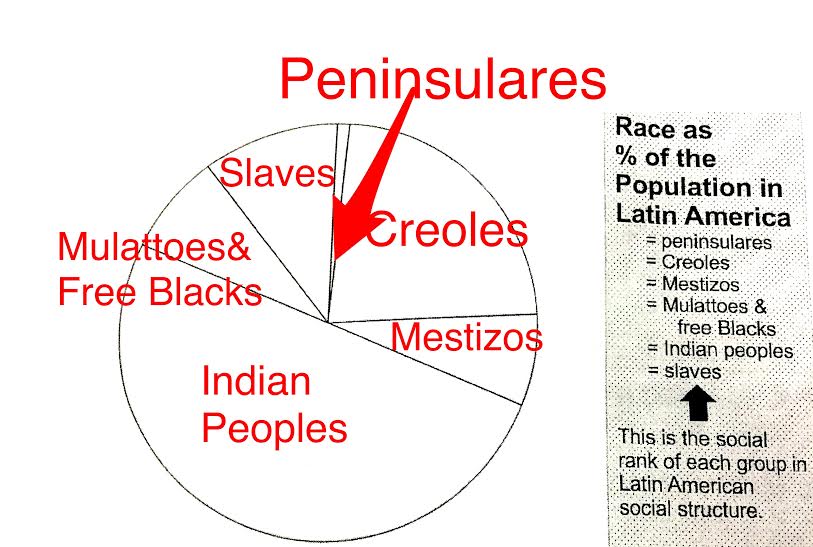
The social ranking started with the most powerful:
  • Peninsulares (Born in Europe)
  • to Creoles (European parents)
  • then Mestizos (European parent/Native parent)
  • Mulattoes (European parent/African parent) and Free Blacks
  • Natives
  • and finally African slaves were the very bottom of the social pyramid
Peninsulares = less than 1%
Creoles = 23%
Mestizos = 7%
Indian People = more than 50%
Mulattoes & Free Blacks = 8%
Slaves = 11%
This was severely unfair not simply because of the lack of reasoning in judging a person’s worth by race but also since the most powerful group of people was also the smallest.

The revolutions we discussed were the Mexican, Gran Colombian, and Brazilian revolutions; my group had Mexico specifically so this is the timeline of events for the Mexican Revolution:

Of the three different revolutions we studied there were similarities between each country’s fight for independence. Brazil, Mexico, and Gran Colombia all fought against European rule and had some points of success in their revolution, splitting their ties from Europe. However, after gaining freedom, the first ruler of each newly independent nation did not last long and quickly lost their new-found power. As each was a different situation, there were also stark contrasts between the revolts too. The revolution of Brazil was significantly less violent than the others, no major warfare broke out as a result of wanting independence. Then, in Gran Colombia, from their revolution emerged several new independent countries as opposed to just one in the others. Small countries split off from Mexico as well but not until later. Nevertheless, the main comparison between the revolutions, and the reason we learned them all together, is the involvement of racial inequalities in each rebellion. In Brazil only Peninsulares were allowed to hold high government positions, they had to rebel because if only Europeans had power the people of Brazil would never be able to change that in itself or anything else. In Mexico the Cry of Delores which began the war directly states that it will stop racial discrimination. In Gran Colombia all different people of color banded together with the common goal of fighting the Spanish to stop racial discrimination.


Today race is still a large issue. Latino, Middle Eastern, and Black people are probably the most oppressed races in America currently. They are the most likely to be stopped by police for no reason and randomly selected to get checked at places like airports. Racism is deeply ingrained into society and so common that it tends to go unnoticed by people who are unaffected by the negative consequences. They assume that if there is not direct hatred for a group of people like a straight up “I hate black people” then racism does not exist, but it does in the way that there is already a system of inequality set up to make it much easier for a white person to gain power and money than a person of color. A white man with a criminal record is more likely to be hired than a clean black man competing for the same job. The media is a strong source of subtle racism that can influence opinions about a group of people well enough to trick a whole race of people into believing it doesn’t even exist. Most characters are played by white people and once people of color come in, they play mainly characters as stereotypical as possible or at least a certain aspect of their stereotype is played up. This leads to a subconscious type of racism where we begin to assume about a person by what we’ve seen of their race in media. It also makes white features the standard of beauty and makes it hard for people of color to identify with characters they like giving them a sense of displacement. (Also, why is Jesus depicted as a white dude when he’s from the middle east?) Black people are usually played up to be more “ghetto” and are shown in the role of being less educated and more aggressive than other races. That causes a superiority vibe amongst non-black people and can lead to unwarranted treatment of other races. 

Right now in American cities across the nation people are beginning to see the injustice for themselves, a recent increase in publicity for the Michael Brown situation has called attention to the amount of uncalled for violence towards innocent black people from white police officers. However, during these protests and trials there are many white people defending the police officers actions, as if possibly robbing a convenience store is reason enough to be murdered. If it somehow was though, it would only be fair if white people who robbed convenience stores were also shot repeatedly for their heinous crime. There are many claims disputing race as a factor in the situations altogether but statistics can show the actual race targeting of crime over many years. Just because racism isn’t happening to them, many try to erase its existence altogether. I personally have heard a white person say that white people have been through just as much as other races. This is why we need to study things like Latin America’s revolutions and slavery in school. We came to this half of the globe and forced our kind into power and enslaved people of other races yet today we deny those facts and even try to keep them out of history books so we can continue celebrating Christopher Colombus and mourning the holocaust while we ignore the American genocide of Native Americans. (The holocaust was horrible and should be remembered I am just pointing out how we ignore our own past genocides) 

There is a large amount of white privilege ignored by those who have it as they continue to publicize crimes against white people over things happening to other races and deny the existence of any racism. White people often get offended by things like white privilege, they feel they are being classified as racist, that they are being grouped together and judged solely on the color of their skin, and they don’t like it. This tends to end in discussions about “reverse racism” and then the consequential argument that all racism is just racism not reverse. But both of these things are actually wrong in their own ways. There can be racist comments/actions towards white people. (I heard a kid once say black babies were smarter than white babies) However, pure racism, the actual societal oppression, does not exist towards white people. We still hold the positions of power and have privilege that cannot be rejected. The stats of this very lesson, the population %s and social ranking pyramid, show that this is how it has always been and you can’t say that we’ve been just as oppressed as other races have, since we’ve been doing the oppressing for a long time.


Links:
https://www.tumblr.com/search/white+privilege
https://life.indiegogo.com/fundraisers/fund-for-the-children-of-eric-garner#description
http://forcechange.com/124425/punish-police-for-seriously-injuring-unarmed-14-year-old/

Monday, December 15, 2014

Toussaint DBQ

Recently in America, we had elections to vote for congress, senate, and other types of governmental leadership. Picking a leader is always a long and controversial process because there are many characteristics a leader must possess and no one ever agrees on which are the most important and if they outweigh the negative qualities of the person. Political skill, toughness, moral leadership, honesty, eloquence, compassion, and humor are all valued differently depending on the needs of the country and the personal experience of whoever is judging. Abraham Lincoln is the most popular president of the United States. He may have been nicknamed Honest Abe but his honesty was not the reason he’s so well liked as a leader, he had strong morals which resulted in the abolition of slavery in America. Haiti around the 1780s, then named Saint Domingue, was France's most profitable colony thanks to the half a million African slaves working the vast 8,000 plantations covering the island. Saint Domingue needed a someone to lead them in a war for freedom and then rule them in a way that maintains the economy and protects the people. Toussaint Louverture was exactly what they needed. He was morally strong and tough as nails while making smart political decisions for his country. Toussaint Louverture should be remembered as a liberator of slaves, military commander, and the ruler of Saint Domingue.

Toussaint’s role as the liberator of slaves was the most important aspect of his leadership because it was the reasoning for almost every decision he made as a ruler. He began his work as an abolitionist in 1791 in the war against France’s enslavement laws, as a doctor to the troops a commander of his own small group of soldiers. (Doc A) He continues fighting, gaining power and support, until the French eradicate slavery in 1794. (Doc A) The Saint Domingue Constitution of 1801, created and signed by Toussaint himself ensures the termination of slavery in a very clear manner stating that “There cannot exist slaves in this territory, servitude is therein forever abolished. All men are born, live and die free and French.” (Doc C) He remains loyal to his cause regardless of what country he’s supposedly for. Once Napoleon gains control of France the freedom of the ex-slaves is once more going to be taken away. When Toussaint learns of this he threatens fighting his own country to death saying how “if they had a thousand lives, they would sacrifice them all rather than be subjected again to slavery” (Doc B) No matter what, he prioritized liberating slaves before anything else so he should be remembered the same way, as the liberator of slaves, before anything else.

In the fight for freedom, Toussaint became a powerful military commander against slavery’s supporters. His intelligence and bravery made him a trusted leader for his troops and made them a more than capable force in their battles. In Napoleon’s conquest to enslave the newly freed people once again 31,131 troops landed in Samana, a port city of Saint Domingue, ready to fight against Toussaint’s army. But with an inspiring battle cry and brilliant plan from Toussaint himself, the cities they arrived in had been decimated and his troops had taken up base in the mountains.(Doc F)  Napoleon’s soldiers had none of the resources, campsites, or regional knowledge they planned and two years later they withdrew from the country. (Doc F) However, Toussaint’s military command was not all positive, as with any war, he had to do harsh things to establish control sometimes. Toussaint’s adopted nephew, Hyacinthe Moyse, had been appointed commander of the Northern Department and in October of 1801 there was a massacre on the Northern Plain. (Doc E) The revolting men cried “General Moyse is with us - death to all the whites.” (Doc E) Toussaint had to prevent this from happening again and so he picked out men from the rebelling troops and made them shoot themselves in the head. He also then called for the firing squad execution of his nephew and had Moyse call the fire order. (Doc E) His harsh punishment was very effective in stopping revolts. Toussaint was strategic in his battles and ruthless when needed, we should remember this part of his life for the fights it won him and the success it brought the country.

After winning the country’s independence, Saint Domingue now needed someone to restructure its government in a way that excluded slavery. Toussaint Louverture was that person. He was named governor for life in an attempt to make the transitional time of the country go a lot smoother. (Doc C) He was already trusted and well known, providing a constant for the people while changes ensued. However, while he was very important and a prominent figure, Toussaint was not the most popular ruler, hence the revolts involving his nephew. Toussaint’s constitution states that slavery is abolished but also encourages agricultural work where the owner of the land has power and workers share in the profits. (Doc C) This is not a crowd-pleaser and soon he issues a proclamation, enforcing his statements about agricultural work. Citizens can be arrested if they don’t do what they’re supposed to, managers and workers had different punishments depending on the offense. (Doc D) The new freedom had provided people with the option to not work and let themselves be impoverished if they so pleased. This led to most agricultural workers quitting, a huge issue since the island’s main source of economic wealth came from plantations and farming. Toussaint knew he was forcing the people to work under the same conditions they had before but he had to enforce it in order to prevent the country’s complete failure. It was hard for many and a questionable decision but Toussaint did lead the first successful slave revolt and keep the country strong in the face of financial collapse. He may not have made the right decision in the eyes of some people but he was a valuable leader and his impact is important to study today.

Although Toussaint Louverture made some rules and decisions that not everyone agrees were right, his moral compass was always pointing the right way and that cannot be denied from any point of view. His work as the liberator of slaves was not only the entire reason he became a military commander and later ruler of Saint Domingue, but also resulted in the most successful slave revolt ever. He freed hundreds of thousands of humans from the torturous life of enslavement and should be remembered for that accomplishment above all else. His command of the military was the next best aspect of his achievements, inspiring and training troops of unprofessional slaves so well that they defeated some of the greatest militaries in the world at the time. His leadership extended into ruling the nation he saved, his display of power may have seemed severe at times but it was what the country needed in order to prosper. His triumphant legacy should live on forever, Toussaint Louverture: Liberator of Slaves, Military Commander, and Ruler of Saint Domingue.


Sources
Document A: Created from various sources.
Document B: Toussaint Louverture “Letter to the French Directory, November 1797.”
Document C: The Saint Domingue Constitution of 1801. Signed by Toussaint Louverture in July 1801.
Document D: Toussaint Louverture, “Proclamation, 25 November 1801.”
Document E: Madison Smartt Bell, Toussaint Louverture: A Biography, 2007.
Document F: William Wells Brown, “A Description of Toussaint Louverture,” from The Black Man, His Antecedents, His Genius, and His Achievements, 2nd edition, 1863. Engraving of Toussaint Louverture, 1802.